Prediction Markets in Canada: Everything You Need to Know (2026)
Last updated: September 11, 2026. We review this guide every quarter and within 48 hours of any major regulatory or platform change.
Prediction markets arrived in Canada in 2026. In March, the country’s investment regulator opened a narrow door. In July, Wealthsimple walked through it with a consumer app. As a result, Canadians who once watched Polymarket and Kalshi from the sidelines can now trade some event contracts legally. However, “some” is doing a lot of work in that sentence.
This guide covers the basics: what a prediction market is, what is legal in Canada, who regulates what, which platforms you can use, how winnings are taxed, and whether anyone actually makes money. We also link out to a deeper article on each topic. Treat this page as your starting point, not the last word.
What Is a Prediction Market?
A prediction market is an exchange where people trade contracts tied to the outcome of a future event. Each contract pays a fixed amount if the event happens, and nothing if it does not.
The price is the defining feature. Picture a contract that pays $1 when an event occurs, currently trading at 65 cents. That price tells you the market sees roughly a 65 percent chance of that outcome. In short, price is probability. This is what separates a prediction market from a lottery ticket. It is also why economists treat these markets as forecasting tools, not simple wagers.
Who takes the other side is the second defining feature. In traditional betting, you wager against the house, at odds the house sets. On a prediction market, you instead trade against other participants. The price moves as they buy and sell. Meanwhile, the platform only matches trades and takes a fee. Therefore, it never profits from your loss the way a bookmaker does.
Globally, common categories include economic data, interest rates, company results, climate, elections, and sports. Canada, however, permits a much narrower list, which the next section explains. For the full mechanics behind order books and pricing, see our companion guide, How Do Prediction Markets Work?
How Do Prediction Markets Work?
The mechanics are simpler than the jargon suggests.
First, you choose a market: a yes or no question with a set resolution date and a source of truth. Then you buy contracts on the side you believe is underpriced. Contracts trade between zero and one dollar. When the event resolves, the winning side pays out at $1 per contract. The losing side ends up worth nothing.
You never have to wait for resolution, either. Contracts trade continuously, so you can sell before the event settles. That locks in your gain or loss at the current price. As a result, prediction markets feel closer to trading than to a bet slip.
How prediction market odds translate into probabilities
Converting odds is straightforward. A contract at 22 cents implies a 22 percent chance. A contract at 91 cents implies 91 percent. Your potential return runs the other way. Buy at 22 cents, and a correct call returns roughly 4.5 times your stake, because you paid 22 cents for something that pays a dollar. Buy at 91 cents instead, and a correct call returns only about 10 percent.
The yes and no sides of a market should add up to roughly $1. The gap between them, called the spread, is a real cost, and it widens on thinly traded markets. Consequently, low-volume markets are usually worse value than they first appear.
How prediction market contracts settle
Every contract names its resolution source in advance. That source might be a Statistics Canada release, a central bank announcement, or an exchange settlement price. Once it publishes, the contract settles automatically. If a dispute arises, the exchange rulebook handles it, not the app you traded through.
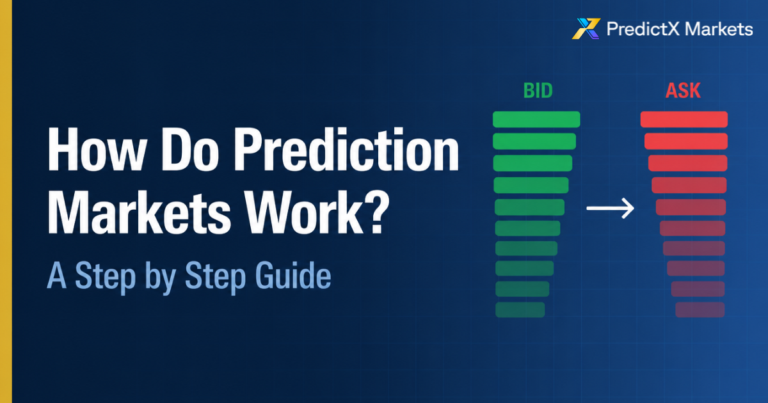
This detail matters more for Canadians than it might elsewhere. The contracts available here clear on United States exchanges regulated by the CFTC, not on a Canadian exchange. For a full walkthrough of order books, spreads, and settlement, read How Do Prediction Markets Work?
Are Prediction Markets Legal in Canada?
Here is the honest 2026 answer. A small, tightly defined set of prediction market contracts is legal for Canadians, offered through two authorized dealers. Almost everything else that made prediction markets famous internationally remains unavailable here.
Two things had to happen first.
First, the Criminal Code reserves gaming and betting to provincial governments. It prohibits lotteries and betting schemes unless a province conducts and manages them. That is why every legal sportsbook in Ontario or Alberta operates under a provincial framework. An independent prediction market simply does not fit inside that exception.
Second, Canadian securities regulators had already closed the other obvious door. Since December 2017, Multilateral Instrument 91-102 has prohibited selling any binary option under 30 days to an individual. Regulators wrote that rule to stop binary options fraud. It happens to describe most contracts on a global prediction market, too. So between these two frameworks, prediction markets sat in a legal gap that nobody could occupy.
Which prediction markets are legal in Canada right now
That changed on March 26, 2026. The Canadian Investment Regulatory Organization (CIRO) published Administrative Bulletin 26-0076, Application of CIRO Requirements to Event Contracts. It created a narrow pathway. Now, authorized CIRO Investment Dealer Members may facilitate trading in a limited set of event contracts. Those contracts must trade and clear through CFTC-regulated exchanges.
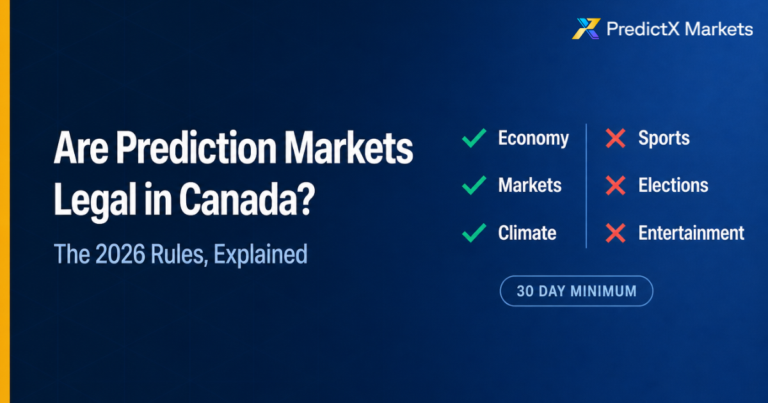
The conditions are strict. Only three subject categories qualify: economic indicators, financial markets, and climate. Every contract needs a minimum 30-day term to maturity, and dealers cannot offer leverage. So far, only two dealers hold authorization: Interactive Brokers Canada Inc. and Wealthsimple Inc.
We cover this topic in full in Are Prediction Markets Legal in Canada? The 2026 Rules, Explained, including the OSC’s Polymarket enforcement action and the province-by-province picture.
Who Regulates Prediction Markets in Canada
This is the part most people misunderstand, and it explains almost every apparent contradiction you will run into. Canada regulates this activity through two separate legal systems that rarely talk to each other.
The securities lane: event contracts as derivatives
In this lane, an event contract counts as a derivative. Provincial securities and derivatives law governs it, administered by the Canadian Securities Administrators, with CIRO overseeing the dealers. Wealthsimple and Interactive Brokers both operate here. This lane also explains why the permitted categories stay narrow. It is also why the 30-day floor exists, and why every contract must clear on a CFTC-regulated venue.
The gambling lane: the Criminal Code and provincial regulators
In this second lane, betting on an outcome counts as gaming. The Criminal Code governs it, alongside provincial bodies like the Alcohol and Gaming Commission of Ontario and iGaming Ontario. Alberta’s framework also lives here; it opened to private operators on July 13, 2026. Sports betting belongs in this lane too. Ontario’s regulated online market alone handled roughly C$82.7 billion in wagers during its 2024 to 2025 fiscal year.
Crucially, these two lanes have different regulators, different rules, and different consumer protections. Nothing in either framework lets one platform legally serve both lanes at once. That is exactly why a single app can offer you a Bank of Canada rate contract, but never a hockey game.
Prediction Markets Canada: What You Can Actually Trade in 2026
Wealthsimple prediction markets: the Predict app
Wealthsimple received CIRO authorization in March 2026. It announced Wealthsimple Predict on June 18, then launched the app publicly on July 29. Notably, it runs as a standalone app rather than a feature inside the main Wealthsimple product.
At launch, it carried close to 4,000 event contracts sourced from Kalshi, the largest US prediction exchange, filtered to categories Wealthsimple can legally offer. In-app categories include Canada, Markets, Companies, Economy, and Climate. Typical questions cover Bank of Canada rate decisions, inflation prints, index levels, and results at Canadian listed companies.
We reviewed the app in depth in Wealthsimple Predict Review: What Canadians Can Actually Trade, including the Kalshi partnership and the litigation attached to it.
Interactive Brokers prediction markets Canada: the quiet first mover
Interactive Brokers Canada was authorized first, in 2025, and offers ForecastTrader contracts through ForecastEx. Coverage looks similar in spirit: whether a given year sets a temperature record, whether the economy meets a defined recession condition, or whether an index clears a threshold by a set date. It reaches a smaller, more experienced audience than a four-million-client consumer app. So most Canadians only heard about prediction markets once Wealthsimple launched.
Questrade has publicly signalled interest in offering event contracts. It is not yet among the authorized dealers, as of this update.
Is Polymarket Legal in Canada?
Polymarket is not available to Ontario residents. In April 2025, it settled with the Ontario Securities Commission over offering event contracts, including sports and politics markets, to Ontarians, in breach of the binary options prohibition. The resulting ban runs until 2027. Polymarket geo-blocks the province at the platform level, too. Elsewhere in Canada, it operates without any provincial or CSA approval. That is a very different thing from being permitted.
Kalshi Canada access: only through a dealer
Kalshi does not onboard Canadian retail users directly. Instead, Canadians reach Kalshi contracts only through an authorized dealer, currently Wealthsimple Predict. Even then, only the subset of listings that fits the three permitted Canadian categories shows up. Notably, the Kalshi brand never appears inside the Wealthsimple app itself.
Prediction markets Ontario: the strictest province
Ontario sits at both extremes. It carries the Polymarket ban in the securities lane. Yet it also runs Canada’s largest regulated online gambling market in the gaming lane. So any product touching Ontario players has to get both sides right, at once.
One point deserves a direct warning, since search results are full of workarounds. Using a VPN to reach a platform that has excluded your jurisdiction breaches that platform’s terms. It can freeze funds and forfeit balances. And it never makes the underlying activity legal. This guide will not explain how to do it, and neither should any source you trust.
Prediction Markets vs Sports Betting vs Investing
| Prediction markets (Canada, 2026) | Regulated sports betting | Long-term investing | |
|---|---|---|---|
| Who sets the price | Other participants | The operator | Public markets |
| Who you trade against | Other participants | The house | A counterparty in an open market |
| Regulator | CSA members and CIRO | Provincial gaming regulators | CSA members and CIRO |
| Permitted subjects | Economy, markets, climate | Sports and gaming | All listed securities |
| Minimum term | 30 days | None | None |
| Leverage | Not permitted | Not applicable | Available in some accounts |
| Payout structure | Fixed, $1 or nothing | Fixed odds | Open ended |
The comparison that matters most sits in the payout row. A prediction market contract has a hard ceiling. The best outcome is that a contract bought below $1 settles at $1. A share in a growing business carries no such cap. That is exactly why regulators keep drawing a line between this activity and ordinary investing.
How Are Prediction Markets Taxed in Canada?
No CRA guidance exists yet for prediction markets specifically, and no Canadian case law addresses it either. What follows is a summary of the framework tax practitioners are currently applying, not advice. Anyone with real money at stake should speak to a Canadian tax professional about their own situation.
Canada usually does not tax casual gambling winnings, since it treats them as windfalls rather than income from a source. Three factors, however, make that windfall argument harder for prediction markets than for a lottery ticket.
First, the contracts genuinely resemble derivatives. They trade continuously on a regulated exchange; they can be sold before resolution, and they settle against a published data source. Second, the platform’s own regulated status works against you. Contracts cleared on a CFTC-regulated exchange are, by design, financial instruments, not informal wagers. Third, your own behaviour drives the outcome. The CRA weighs frequency, holding period, sophistication, and organization. Occasional recreational positions sit closest to windfall treatment. Systematic or automated trading, however, points toward fully taxable business income instead of capital gains.
Losses follow the same logic: recreational losses are not deductible, though business losses generally are. One more note applies if you hold foreign assets, stablecoins on an offshore platform included. Once the total cost base clears C$100,000 at any point in the year, form T1135 reporting can apply.
Can You Make Money on Prediction Markets?
Most people cannot, and this is the part the marketing tends to leave out.
A 2026 study examined 1.4 million Polymarket users and roughly US$20 billion in trading volume, from November 2022 to March 2026. Researchers came from ESSEC Business School, HEC Montréal, and the University of Toronto. It found that 70.8 percent of users finished the period in the red, while the top 1 percent of traders captured 84 percent of all gains. The median user lost money overall.
That distribution is not an accident, either. Prediction markets are zero-sum before fees, and negative-sum after them. Every dollar a winner takes came from a losing participant, minus the spread and the platform’s cut. Winning consistently, therefore, requires being better informed than everyone else trading the same question, again and again.
None of this makes prediction markets useless, though. They remain genuinely good aggregate forecasting instruments. Real hedging use cases exist too: a variable rate mortgage holder taking a position on rate increases has a genuine economic reason to be there that a casual participant lacks. Still, the case for participating is far stronger for a hedger or a specialist than for someone acting on a hunch.
If your engagement with any market ever stops feeling like a decision, and starts feeling like a compulsion, help is available. Provincial problem gambling services operate across Canada, including the ConnexOntario helpline at 1-866-531-2600.
Where Prediction Markets in Canada Go Next
Three developments are worth watching over the next year.
More dealers will likely join. CIRO built an application pathway rather than a one-time exemption, so the roster of authorized firms should grow. Each new entrant expands access without changing the permitted categories.
Pressure on the category list may build. Sports remains the largest prediction market category globally, yet it stays entirely excluded here. Expanding it would collide directly with the gaming lane. So any movement is more likely to come from provincial gaming frameworks than from securities regulators.
Further guidance could arrive at any time. Both the CSA and CIRO have said they continue monitoring this space. Either could tighten the rules as easily as loosen them. So treat nothing here as settled.
Overall, the direction of travel points toward more access under continued tight supervision. The pace, though, depends on how the first year of consumer trading unfolds.
Explore the Rest of Our Prediction Markets Canada Guide
This pillar page covers the basics. For the deeper dive on any topic, start here:
- New to the concept? Read What Is a Prediction Market? A Plain Language Guide for Canadians
- Want the mechanics? Read How Do Prediction Markets Work?
- Need the legal detail? Read Are Prediction Markets Legal in Canada? The 2026 Rules, Explained
- Considering Wealthsimple Predict? Read Wealthsimple Predict Review: What Canadians Can Actually Trade
Prefer updates in your inbox instead? Join The Briefing by PredictX, and we will flag every regulatory and platform change as it happens.
Prediction Markets in Canada: Frequently Asked Questions
Legality and access
Are prediction markets legal in Canada? Partly. Since March 2026, two CIRO-authorized dealers, Interactive Brokers Canada and Wealthsimple, can offer Canadians a limited set of event contracts. Categories are capped at economic indicators, financial markets, and climate, each with a minimum 30-day term. No prediction market platform itself is registered or recognized in Canada.
Can Canadians use Polymarket? Not in Ontario, where a 2025 OSC settlement bans Polymarket until 2027 and the platform blocks access accordingly. Elsewhere in Canada, Polymarket operates without CSA or CIRO approval. So users get none of the protections that come with a regulated dealer.
Can Canadians use Kalshi? Not directly, since Kalshi does not onboard Canadian retail clients. Instead, Canadians access a filtered subset of Kalshi contracts through Wealthsimple Predict.
Why can’t Canadians bet on elections or sports through prediction markets? Both fall outside the categories CIRO authorized. Regulators view political markets as carrying manipulation and integrity risk. They also treat sports outcomes as closer to gambling than to derivatives, and sports wagering already falls under separate provincial regulation.
Money and mechanics
Are prediction markets gambling? Legally, they sit in the securities lane here, not the gaming lane. Economically, though, they share features with both. Peer-to-peer pricing and hedging use cases sit on one side; fixed binary payouts and speculative appeal sit on the other. The legal answer and the behavioural answer are simply not the same answer.
How are prediction market winnings taxed in Canada? No specific CRA guidance exists yet. Depending on how frequently and systematically you trade, gains may count as a windfall, a capital gain, or business income. Trading on a regulated exchange weakens the tax-free windfall argument. So speak to a Canadian tax professional before assuming either treatment applies.
What is the minimum contract length in Canada? Thirty days. Multilateral Instrument 91-102 prohibits binary options with a shorter term for individuals. CIRO’s framework applies that same floor to event contracts.
Do most people make money on prediction markets? No. A 2026 study covering 1.4 million Polymarket users found that around 71 percent finished in the red. The top 1 percent of traders took 84 percent of all gains.
This article is educational and is not legal, tax, investment, or financial advice. It does not describe or promote any PredictX product. Because regulations in this area change quickly, verify the current position with the regulator or a qualified professional before acting.