Are Prediction Markets Legal in Canada? The 2026 Rules, Explained
Last updated: September 11, 2026. Reviewed quarterly.
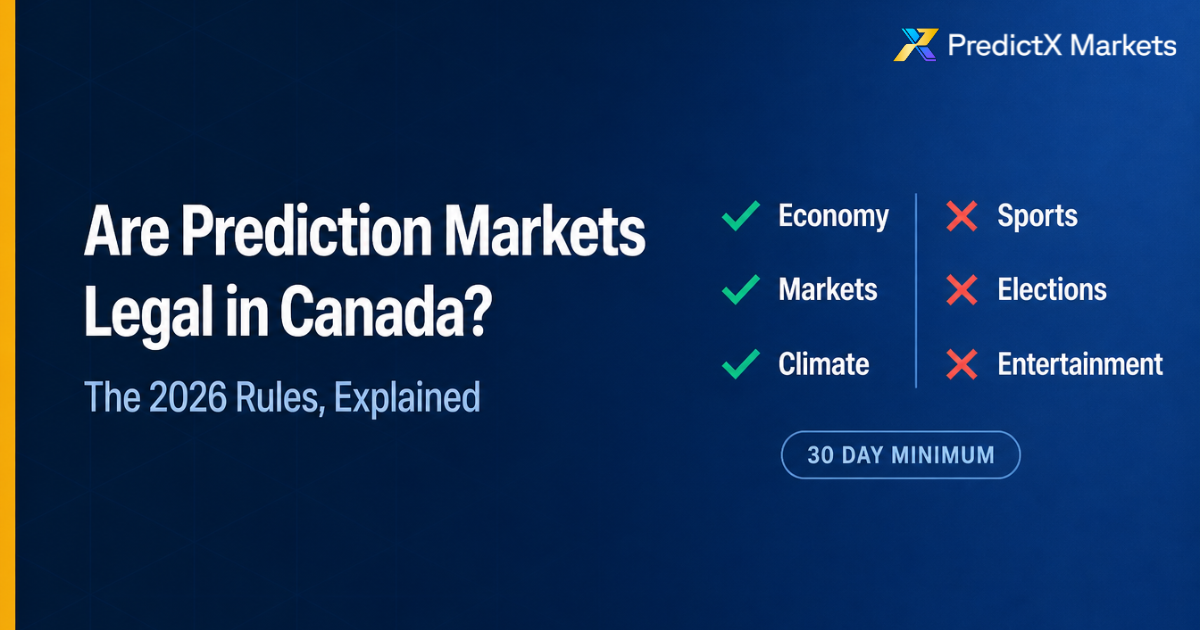
Are prediction markets legal in Canada? Here is the short answer: partly. Since March 2026, two authorized investment dealers may offer Canadians a narrow set of event contracts. Categories stay limited to economic indicators, financial markets and climate, each with a minimum 30-day term. Sports, elections and entertainment contracts are not permitted. No prediction market platform is itself registered or recognized in Canada. Polymarket, meanwhile, stays banned in Ontario until at least April 2027.
That is the whole answer. The rest of this article explains why the rules look this way, which is the part almost nobody gets right.
Why Were Prediction Markets Illegal in Canada Until 2026?
Two legal frameworks blocked them. Confusing the two produces most of the bad information you will find online.
The binary options ban and the 30-day rule
In December 2017, Canadian securities regulators brought in Multilateral Instrument 91-102, the Prohibition of Binary Options. It prohibits offering or selling any option to an individual that contains a yes-or-no proposition about a future price or event. That option cannot carry a term under 30 days. And it must pay a fixed amount if the proposition is met, and nothing if it is not.
Read that definition again: it precisely describes a standard prediction market contract. Regulators wrote the rule to stop binary options fraud, and in doing so closed the door on an entire category before it became popular.
The Criminal Code and the provincial gaming monopoly
The other closed door was the Criminal Code. It prohibits lotteries and betting schemes unless a provincial government conducts and manages them. That is why every legal sportsbook in Ontario or Alberta operates under a provincial framework rather than a federal licence. An independent platform taking positions from Canadians on future events simply does not fit inside that exception.
So between the two frameworks, no lawful space existed for a prediction market to occupy. That is the honest answer to why prediction markets were illegal in Canada. It sits in the past tense because it changed in 2026.
What Prediction Markets Are Legal in Canada Right Now?
On March 26, 2026, the Canadian Investment Regulatory Organization published Administrative Bulletin 26-0076, Application of CIRO Requirements to Event Contracts. It created a pathway. Now, authorized CIRO Investment Dealer Members may facilitate client trading in a limited set of event contracts. Those contracts, however, must trade and clear through exchanges regulated by the US Commodity Futures Trading Commission.
The conditions, however, stay tight.
The three permitted event contract categories
Only three subjects qualify: economic indicators, financial markets and climate. In practice, that means central bank rate decisions and inflation data. It also covers index and currency levels, listed company results, and temperature or precipitation benchmarks.
Sports, elections, entertainment and pop culture are not on the list. Those happen to be the categories that made prediction markets famous internationally. So they are exactly what Canadians still cannot trade through a dealer.
Two further constraints apply, too. First, every contract must carry a term to maturity of 30 days or longer, mirroring the binary options ban. Second, issuing a new threshold on an existing contract counts as a new contract, which must also clear 30 days. Dealers, meanwhile, may not permit leverage or margin on any of it.
Which dealers are authorized to offer event contracts
Two dealers hold authorization as of this update. Interactive Brokers Canada Inc. was authorized in 2025 and offers ForecastTrader contracts through ForecastEx. Wealthsimple Inc., meanwhile, was authorized in March 2026 and is now live with the Wealthsimple Predict app. Any other dealer must first notify CIRO in writing and file a material change application. Questrade has signalled interest, though it is not yet among the authorized firms.
On April 2, 2026, the CSA and CIRO also issued a joint reminder. Anyone trading or facilitating trading in event contracts that qualify as securities or derivatives must satisfy registration and recognition requirements. In short, the dealers hold authorization. The prediction markets themselves do not.
Is Polymarket Legal in Canada?
Not in Ontario, and not with Canadian approval anywhere else.
On April 17, 2025, the Capital Markets Tribunal approved an OSC settlement with Blockratize Inc. and Adventure One QSS Inc., Polymarket’s current and former operators, over binary options offered to Ontario investors between June 2020 and May 2023. The settlement carried monetary sanctions plus two-year bans on trading securities or derivatives, running to April 2027. Polymarket restricted Ontario access in May 2023, at the OSC’s request, and still lists it as a blocked region.
Outside Ontario, Polymarket carries no CSA registration, no CIRO authorization, and no provincial gaming licence. So “not yet subject to an enforcement order in your province” is very different from “legal.” It also carries none of the protections a Canadian dealer relationship provides.
One related point deserves a warning, since search results are full of workarounds. Bypassing a geographic block breaches the platform’s terms, can freeze balances or forfeit funds, and never changes the legal status of the activity. This article will not explain how.
Are Prediction Markets Legal in Ontario, Alberta and BC?
The securities rules are effectively national. MI 91-102 and the CIRO framework apply across every participating jurisdiction. So a dealer’s client in Halifax faces the same permitted categories as one in Vancouver.
Provinces diverge on enforcement and on the gaming side. Ontario is the most active enforcer, holding the country’s only prediction market settlement so far, and it runs Canada’s largest regulated online gambling market. Alberta opened its regulated iGaming market to private operators on July 13, 2026. Those frameworks govern sports betting, not event contracts. So far, no province licenses a peer-to-peer prediction market as a gaming product.
Can Canadians Participate in Prediction Markets Legally?
Yes, within the boundaries above. Opening an account with an authorized dealer and trading permitted contracts is lawful. The obligations in MI 91-102 fall on the firms offering these products, not on retail participants. An unregistered offshore platform is different: no Canadian protection applies, and the tax treatment carries no CRA guidance behind it.
Will Prediction Markets Be Fully Legalized in Canada?
The current framework is a controlled first step, not a settled endpoint.
More dealers should join. CIRO built an application process, not a one-time exemption, so the roster of authorized firms should grow. That widens access without changing what can be traded.
The category list may face pressure. Sports remains the largest prediction market category globally, yet it stays entirely excluded here. Expanding it would run straight into provincial gaming jurisdiction. So any movement is more likely to come from gaming regulators than from securities regulators.
Further guidance could still arrive. The CSA and CIRO both say they continue monitoring the space. Either could tighten the rules as easily as loosen them.
Prediction Markets and Canadian Law: Frequently Asked Questions
Legality basics
Are prediction markets legal in Canada in 2026? Partly. Two CIRO-authorized dealers, Interactive Brokers Canada and Wealthsimple, may offer a limited set of event contracts. Categories stay capped at economic indicators, financial markets, and climate, each with a minimum 30-day term. No prediction market platform itself is registered or recognized in Canada.
Why are prediction markets restricted in Canada? Two frameworks apply. MI 91-102 has banned binary options under 30 days since 2017. The Criminal Code, meanwhile, reserves betting schemes to provincial governments. Together, they left no lawful space for an open prediction market until CIRO created a narrow pathway in March 2026.
Is Polymarket legal in Canada? Not in Ontario. An April 2025 OSC settlement imposed bans running to April 2027, and Polymarket geo-blocks the province accordingly. Elsewhere in Canada, it operates with no CSA or CIRO approval, so no Canadian regulatory protection applies.
Can Canadians bet on elections through prediction markets? No. Election and political contracts fall outside the three authorized categories, so no Canadian dealer may offer them.
Practical questions
Are prediction markets gambling under Canadian law? The authorized contracts sit in the securities and derivatives lane, regulated by CSA members and CIRO, rather than the provincial gaming lane. Sports wagering works the other way around. It counts as gaming, not securities.
Do Canadians break the law by trading on prediction markets? No, not in the sense of individual liability. The obligations in MI 91-102 and CIRO’s framework apply to the firms offering these products, not to retail traders. Using an unregistered offshore platform is not an offence in itself, but it does mean trading without any Canadian protection.
What is the 30-day rule for prediction markets in Canada? Every permitted event contract must carry a term to maturity of at least 30 days. This follows directly from the binary options ban, which prohibits fixed-payout yes or no contracts with shorter terms.
This article is educational and is not legal, tax, or investment advice. It does not describe or promote any PredictX product. Because rules here are changing quickly, confirm the current position with the regulator or a qualified professional before acting.
Want the full picture? Read the complete guide, Prediction Markets in Canada: Everything You Need to Know, or join The Briefing by PredictX, and we will tell you when these rules change.